Thursday, April 24

Cookware for Newlyweds


A friend recently went through my blog to see if I had any reviews of cookware, and sadly, my cupboard in that regard was bare. To make up for this deficit, I'd like to add a few thoughts about cookware and how to go about buying it.

Non-Cooking Considerations
I think that all of us who see ourselves as careful chefs would like to say that cooking vessels are purely about optimal function. But, just like food on a plate, the way pots and pans look in the kitchen (since they're not tucked away behind swinging doors with tiny round windows) is important. Picking pots is like picking sneakers, after you've decided on the function, also consider the design. If you hate the way the pot looks, it'll end up at the back of the cabinet.

Sets vs. A La Carte
Sets are great things to put on your registry, but in the end, your pot usage will vary depending on your cooking style. I don't think most sets really give you value over time because you'll end up only using a few pieces consistently.

Form Follows Function
Different sorts of pans do different things well. For example, for braising, you might want to get a Le Creuset dutch oven. Cast iron is ideal for slow cooking and even heat. Le Creuset are well made, last for years, and they're easy to maintain and easy on the eyes thanks to their enamel coatings.

Stainless
For searing, making sauces, and sauteing, you probably want stainless (like all clad). It's non-reactive with acids (like naked aluminum would be) and very durable. It inevitably gets scratched, so don't buy stainless based on a shiny mirror finish. It will soon be gone with regular use.

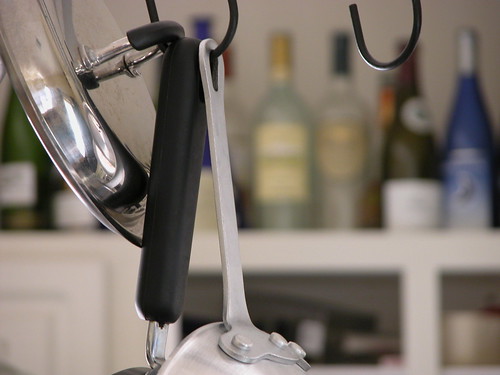
Since stainless gets very hot and will be filled often with heavy ingredients (like steaks), be sure the handle is easy to manage and comfortable. Any decent pan will have a handle that stays cool. Cheaply made pans have spot-welded handles (you can see the small dimples at the base of the handle) whereas well made pans are riveted.

Another hallmark of a well made pan is a layered base construction. Stainless steel, a metal great for cleanup and durability, is unfortunately a pretty poor heat conductor. That's why fancier pans add layers of aluminum and copper to the inside of their bases to compensate. Some of the pans seems to go overboard with a zillion layers, but it's not all just hokum either. Nothing spreads heat more evenly than copper, which is why many add copper to the mix. If you're going to use an induction cooktop (where an electric field heats up the metal instead of flame), you need to have ferrous metal somewhere in the mix. Pans will be marked whether they're for use on induction cooktops or not.

Non Sticks
I would never advocate getting only non-sticks because they don't develop caramelization as well as bare metal, but they're great for delicate foods like eggs that stick. There are new generations of non-stick that that can stand up to metal utensils and being washed in the dishwasher. The key to non-sticks is not to overheat them: the coating breaks down and throws off hazardous gasses when heated to temperatures over 500 degrees, so don't leave them on the heat without food in them or use them in the oven.

Sunday, April 20

The Most Useful Gadget in the Drawer-Simplicity!

photo credit to Silver Bromide on FlickrFor a long time, I've been trying to zen-ify my kitchen tool drawer. A few years ago, I got caught up in specialized doo-dads. One thing to squeeze lemons, another to squeeze limes, and yet something else to peel them. Now I've gotten my drawer down to 7 essential items (not including a few must-have knives) and here they are:

1. A pastry knife/cutter/scraper (I have one that's flexible plastic). This thing works wonders for chunking off bread dough, pasta dough, and scraping batter from the bowl. You could cut bread or pasta dough with a knife, but that's exactly why you need this tool!

2. The medium-small Microplane grater. This works for nutmeg, cheese, and zesting lemons. It's sharp, easy to clean, and you don't need a million different ones. I even use it for pulverizing onions and tomatoes for paella. Don't use it on ginger, though, it cuts the fibers. Instead, just cut up chunks of ginger and pulverize with the back of a wooden spoon and strain with...

3. A medium strainer. This thing is for straining pastry cream, soups and gravies, pulping soft ingredients like ripe tomatoes and banana, or in a pinch you can even make tea with it!

4. A quick read thermometer. I found I need it less as I get more experience cooking meat, but it's a great learning tool, and it can answer any doubts you have over the chicken you just pulled out of the oven or off the grill.

5. Kitchen shears. Get the kind you can take apart and wash, that way you can cut chives one minute and take apart a chicken the next, throw into hot suds or the dishwasher, and then go back for more. (After chicken, I would make sure you wash carefully though, maybe even add a little bleach to the wash water, before using on chives again...just to be safe).

6. A wine tool...enough said. I give myself a freebie on this one, since there's really no substitute. I like is this one. It also doubles as bottle opener for old skool beer or mineral water.

...and since 6 didn't really count as a gadget...

6. A kitchen scale. I've got an inexpensive one that does ounces and grams. It's essential for baking, though unfortunately doesn't get used very often.

7. Measuring spoon set. Sort of counts as a gadget, I guess.

So what do I do about those lemons or limes that need to be squeezed? I roll the citrus under my palm on a counter top using pressure to loosen up the fruit, then slice in half, stick a fork in the pulp and squeeze. Move the fork around a bit to get even more juice.

One final note on gadgets, here is the most egregiously superfluous gadget of all time...behold this misguided, inelegant waste of resources.

Thursday, April 17

The Perfect Pantry 2: Olive Oil

photo credit goes to ShellyAlmost all recipes call for fat. The important question isn't how much, but which one to choose from? In a well stocked pantry, having a variety of fats on hand is not only necessary, but also fun from a flavor standpoint. There are so many varieties to choose from, you could dress a salad or fry some calamari a dozen ways just by switching the oils.

Oils you'd Eat Out of the Bottle
There are a few oils that you'll want hanging around just to add zazz. Olive oil is the obvious one, but peanut oil, mustard seed oil, grape seed oil, and walnut oil all bring varying levels of complexity and flavor to your food. There also oils whose sole purpose in life is to deliver some other ingredient, like garlic infused olive oil or truffle oil.

Olive Oil
The well-stocked pantry has at minimum a high quality "eating" olive oil for fragrance, floral or spicy notes, and velvety roundness for greens, dipping bread into, or putting the finishing touch on everything from fish to flatbread. Like any crave-able food, there are hundreds of nuanced choices ranging from reasonable to ridiculous in terms of price. 

Exploring olive oil can get as narrow as you like, from comparing varietals and harvest years, to as broad as blended brands you can always rely on. For all eating oils, however, stick with extra virgin. It's the yield of the first press, and it has the most flavor. Subsequent pressings employ tricks to get more oil, but the flavor is either already gone or destroyed (for example, from heat) in the process.

California Oils
My choice for a mid-priced, always-on-hand oil is a local (Bay Area) grower called Bariani. They've got a great, unfiltered extra virgin that's a solid, full bodied all-around choice. I don't use this oil for cooking because heat destroys it's complexity, but I'll splash it on almost anything.

When I want to go a bit more upscale, I like Seckinger Arbequina. Arbequina olives are small, brown fruits mainly produced in Spain that produce a uniquely rich and peppery, delicious oil. Becky Seckinger is a fourth generation producer who makes small batch, organic oils that can handle center stage in any dish. She's got a bunch of varietals in addition to arbequina.

Storing Olive Oil
The key to experimenting with oil to try one at a time (in addition to your 'house' oil) since it ages quickly and dies once it's exposed to oxygen. So, in addition to only keeping small quantities on hand, it's best to keep all of your oils, no matter what you choose, in the fridge, not in the cupboard.

Next time, varietals, odd ball, and frying oils.

Photo credit goes to Shelley, who's got a Slow Food blog. Check it out here: http://lfnn.blogspot.com/

Tuesday, April 15

The Well Stocked Kitchen: Start with Salt & Pepper

credit goes to gothick_matt on Flickr
Salt
Alice Waters councels that one thing all cooks can do to immediately improve the taste of their food is replace the iodized salt with pure, unadulterated mineral. Alice's palette is a bit more developed and naturally acute than most of ours, but I'm fully on board with this tip. Replace your morton's iodized with kosher, already! If you're taking a multi-vite or eating kale, you're already getting more than enough iodine. Taste different salts next to each other...iodized salt definitely has a chemical note.

There's been a lot of press about varietal salt: black salt, sel de mer, large crystal, and Himalayan. These varieties are really fun to play with, but they're not essential. If you're intrigued, by all means buy some upscale salt and play around. If you're keeping it simple, buy yourself a big box of kosher salt, and well, salt it away. It's part of your well-stocked pantry.

Pepper
Pepper is as complex as coffee, and many of the same rules about quality apply: good pepper has more complexity, it only grows well in particular parts of the world, it does not age well once ground up, and the good stuff does tend to cost a bit more.

Fortunately, it's easy to find great pepper. Penzey's has a great selection. High quality pepper comes mainly from the east coast of India. Two of the most celebrated varieties are the Tellicherry and Malabar (in order of celebration). If you've never tried Malabar, give it a shot. It's loud and good, but Tellicherry is fruitier and more complex: perfect for salad, where you can really taste every nuance.

To stock the perfect pantry, consider buying a big bag of peppercorns and a good grinder. For producing nuggety cracked pepper, I like Peugeot's hardened steel burr mechanism: they make a variety of body styles, but I would avoid the acrylic one because they flex a little too much. I have the aluminum "Perfex" style. It's small and simple but works reliably year after year.

You can put the rest of the peppercorns in the freezer and use them as you need them, they'll keep fairly well for a couple of months. Salt never goes bad, it's a mineral after all, as long as you keep it dry in an airtight container.

Part 1 of a Series: The Perfectly Stocked Kitchen

The kitchen is a management project. Pots and pans stack up, the pantry goes bare, refrigerator contents age. One way to get a grip on all of it is to rationalize...what do you really, really need? What things make the pleasure of cooking richer? You need a plan.

The Pantry
In part one, let's talk about the pantry because it's crucial to happiness. The pantry is your savior, your comfort, your magic trick, and your ah-ha inspiration. If you don't have an actual pantry, that's ok. The pantry is an idea, not a physical space. Anything you've got that's a base ingredient of more than one finished product, things that polish up or finish dishes, or things provide the foundation for meals like pastas or rice are part of your pantry no matter where they're kept. (If you've got a physical pantry, that's a plus because you can scan it's contents just by turning your head instead of rifling through cabinets, like in my house).

Getting the Obvious Out of the Shopping List
At the very least, pantries ought to have staples like flour, rice, and sugar. But they also need to have flexible components you can put into other things like canned tomatoes, dried beans, and a few blue ribbon items like olive-oil poached garlic, truffle oil, and Tabasco.

Over the next few weeks, I'll be doing an occasional look at what should be in your pantry to make your life easier, your cooking more enjoyable, and keep budget and sanity in check.

Next up: seasonings to keep on hand.