Monday, May 26

Bamboo Shoots Don't All Come in Cans

Thanks to Joi from Flickr for this fabulous picture of bamboo shoots on the board
Recently I bumped into a friend who had come from the Clement street shopping district in San Francisco, an area of the city known for Asian markets. He discovered fresh bamboo shoot, and he said it was remarkably good and totally different than the blanched, beige squares most of us think about swimming in our stir fry at the local restaurant. (Thank you, Remy!)

After hunting around a bit, I found some myself and did a bit of research to figure out what I was looking at. It turns out there are hundreds of varieties of bamboo, but only a few are good eating. For a list of the edible varieties, check out Gib, the bamboo maven. When you shop for bamboo shoots in a market, you're most likely to find giant or sweet bamboo, common eating varieties. Bamboo shoots are harvested when they're just a few inches high.

Preparation
If you're lucky enough to find fresh ones, peel, slice thinly or julienne them, and then boil for 30 minutes or more in plenty of water. Cooking not only softens up the woody fibers and leaches out bitter flavors, but it also dissipates a small amount of hydrocyanic acid, which not only tastes bad, but is...well...poison. So, don't forget to boil! They're done when tender and all traces of bitterness are gone.

What's Different
Fresh bamboo shoots have a firmer, snappier texture and fresh vegetal flavor that gets completely lost in canning. You can use them in salads, for garnish on soup, or of course in your favorite asian dishes. Since they can be cut many ways: paper thin slices, square twigs, or rounds, they make for an interesting visual as well as flavor component. I cut mine into thin sheets and rolled them around rice noodles, fresh basil, barbecued tofu pieces, and a smear of hoisin.

Sunday, May 11

Chillis

Chillis are a fruit and a spice
Chillis are fruit because these often colorful pods bear seeds. And chillis are also a spice because its tender pith (or placenta) yields not only seeds but the pungent chemical capsaicin, a powerful palate burner with which we love to hurt ourselves in salsas, stews, and every manner of sauce. Apparently, we all love a little pain...chillis are the most cultivated spice in the world, followed distantly (a factor of 20) by black pepper.

A native of South America, there are hundreds of varieties of chillis grown throughout the world, though most we commonly eat come from a single species, the capsicum annuum. Those favorites include the bell pepper, jalapeno, ancho, seranno and even cayenne. Scotch bonnets, tabasco and a few others each come from other species, but there are only about five species we eat. No matter what kind you've got, note that chillis are hottest just before they ripen, but as time wears on, the potency wears off.

Making sense of the flavors
Chillis hotness come from capsaicin, a substance produced in the pith that migrates onto the seeds. If you want to remove heat from your chillis, split them in half or quarters and carefully excise the pith and seeds. You won't get rid of all the heat, but you'll reduce it significantly. Heat pungency is measured in scoville units, after Scoville the scientist. The scale is set at 1 for black pepper, and then chillis go up from there. Habaneros can reach 500K scoville units.

There are there are plenty of other flavor components in chillis other than heat, flavors that we regularly mess with and enhance by drying, smoking, and pulverizing. Chillis are in the same broad flavor family with eucalyptus and cinnamon. This family of flavors, the phenolics, are also found abundantly in wine, which in part explains why some wine writers talk about green pepper flavors and aromas when describing aromatic whites.

Choosing chillis
There's no great way to tell what a pepper will taste like, or even it's hotness, just by looking. There's no correlation between size and heat, shape, or flavor that you can rely on when shopping. You can discern ripeness in part by their green color, but the most reliable method for choosing the proper pepper is to sample, settle on a few varieties you like, and keep notes.

Chilli is a thickener
The walls of the chilli fruit are made of cellulose, so when they're dried and ground to a powder, they do a great job at thickening. The balance between their thickening power and the flavor they contribute is key, so make sure you taste before you adjust for thickening. It's easy to overheat a stew or sauce while you're trying to get the texture right.

Monday, May 5

Improvised Ribs

My lousy phone camera shot of ribs
Making Ribs without a Grill
Yesterday my local market had a rack of heritage breed pork ribs. They looked so interesting, and even though I had never made them before (I'm ashamed to say), they looked too good to pass up. Everything I've heard about ribs reinforces slow cooking on a grill. But I had no charcoal and I was hungry. Was this a stupid move? Turned out no, not really.

The idea of slow heat in a shield of sauce is that the moderate heat and moist environment encourages tough connective tissue in the ribs (or any meat) to transform into gelatin. That's how we get that falling-off-the-fork tenderness that we all love in ribs, roasts and stews.

For ribs, brushing with barbeque sauce over a slow fire does the trick. Since grilling wasn't an option yesterday, I broke out the shallow braising pan with a tight lid and got it simmering with just a little stock. I looked for beer at first in the far reaches of my fridge, but all I had was Guinness in the crisping drawer, and I wasn't convinced that would taste all that great.

The 8 rib piece I had bought braised for about an hour and forty-five minutes, just barely bubbling. I watched Hitchock's Rebecca and had a glass of wine while they simmered away in the braising liquid. Definitely a recommended step.

Out of the Braising Pan Into the Fire
About 20 minutes before they were completely braised, I turned off the heat on the top of the stove and switched on the oven set to 400 degrees. As the stove warmed up, I made sauce. I didn't want to use a recipe so I started started with two tablespoons of soy sauce, a teaspoon of prepared mustard, a teaspoon of tomato paste, two heaping tablespoons of honey, a teaspoon (at least) of Frank's Red Hot sauce and a bunch of black pepper. It was decent, but it needed a little vinegar. After a few more adjustments, I decided to add a dash of bitters and some thinly sliced garlic. It was good, so I stopped while I was ahead, and I honestly don't know if the bitters helped.

The sauce was pretty viscous and when I spooned it onto the ribs, so it stuck well. I put the whole thing into a roasting pan and let it go for 20 more minutes. It caramelized nicely and finished tenderizing. They were done!

All in all, slow smoked ribs are better. There's no question. But for ribs in two hours without a grill, I have to say this braise then roast method was a winner, and I'd do it again.

Thursday, April 24

Cookware for Newlyweds


A friend recently went through my blog to see if I had any reviews of cookware, and sadly, my cupboard in that regard was bare. To make up for this deficit, I'd like to add a few thoughts about cookware and how to go about buying it.

Non-Cooking Considerations
I think that all of us who see ourselves as careful chefs would like to say that cooking vessels are purely about optimal function. But, just like food on a plate, the way pots and pans look in the kitchen (since they're not tucked away behind swinging doors with tiny round windows) is important. Picking pots is like picking sneakers, after you've decided on the function, also consider the design. If you hate the way the pot looks, it'll end up at the back of the cabinet.

Sets vs. A La Carte
Sets are great things to put on your registry, but in the end, your pot usage will vary depending on your cooking style. I don't think most sets really give you value over time because you'll end up only using a few pieces consistently.

Form Follows Function
Different sorts of pans do different things well. For example, for braising, you might want to get a Le Creuset dutch oven. Cast iron is ideal for slow cooking and even heat. Le Creuset are well made, last for years, and they're easy to maintain and easy on the eyes thanks to their enamel coatings.

Stainless
For searing, making sauces, and sauteing, you probably want stainless (like all clad). It's non-reactive with acids (like naked aluminum would be) and very durable. It inevitably gets scratched, so don't buy stainless based on a shiny mirror finish. It will soon be gone with regular use.

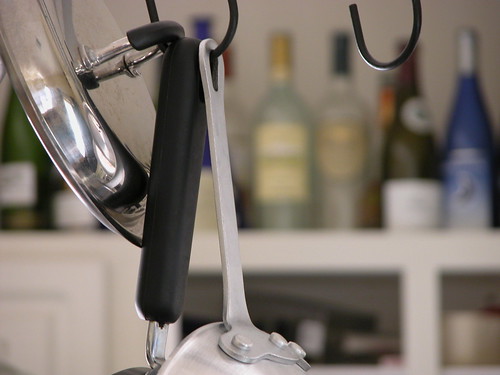
Since stainless gets very hot and will be filled often with heavy ingredients (like steaks), be sure the handle is easy to manage and comfortable. Any decent pan will have a handle that stays cool. Cheaply made pans have spot-welded handles (you can see the small dimples at the base of the handle) whereas well made pans are riveted.

Another hallmark of a well made pan is a layered base construction. Stainless steel, a metal great for cleanup and durability, is unfortunately a pretty poor heat conductor. That's why fancier pans add layers of aluminum and copper to the inside of their bases to compensate. Some of the pans seems to go overboard with a zillion layers, but it's not all just hokum either. Nothing spreads heat more evenly than copper, which is why many add copper to the mix. If you're going to use an induction cooktop (where an electric field heats up the metal instead of flame), you need to have ferrous metal somewhere in the mix. Pans will be marked whether they're for use on induction cooktops or not.

Non Sticks
I would never advocate getting only non-sticks because they don't develop caramelization as well as bare metal, but they're great for delicate foods like eggs that stick. There are new generations of non-stick that that can stand up to metal utensils and being washed in the dishwasher. The key to non-sticks is not to overheat them: the coating breaks down and throws off hazardous gasses when heated to temperatures over 500 degrees, so don't leave them on the heat without food in them or use them in the oven.

Sunday, April 20

The Most Useful Gadget in the Drawer-Simplicity!

photo credit to Silver Bromide on FlickrFor a long time, I've been trying to zen-ify my kitchen tool drawer. A few years ago, I got caught up in specialized doo-dads. One thing to squeeze lemons, another to squeeze limes, and yet something else to peel them. Now I've gotten my drawer down to 7 essential items (not including a few must-have knives) and here they are:

1. A pastry knife/cutter/scraper (I have one that's flexible plastic). This thing works wonders for chunking off bread dough, pasta dough, and scraping batter from the bowl. You could cut bread or pasta dough with a knife, but that's exactly why you need this tool!

2. The medium-small Microplane grater. This works for nutmeg, cheese, and zesting lemons. It's sharp, easy to clean, and you don't need a million different ones. I even use it for pulverizing onions and tomatoes for paella. Don't use it on ginger, though, it cuts the fibers. Instead, just cut up chunks of ginger and pulverize with the back of a wooden spoon and strain with...

3. A medium strainer. This thing is for straining pastry cream, soups and gravies, pulping soft ingredients like ripe tomatoes and banana, or in a pinch you can even make tea with it!

4. A quick read thermometer. I found I need it less as I get more experience cooking meat, but it's a great learning tool, and it can answer any doubts you have over the chicken you just pulled out of the oven or off the grill.

5. Kitchen shears. Get the kind you can take apart and wash, that way you can cut chives one minute and take apart a chicken the next, throw into hot suds or the dishwasher, and then go back for more. (After chicken, I would make sure you wash carefully though, maybe even add a little bleach to the wash water, before using on chives again...just to be safe).

6. A wine tool...enough said. I give myself a freebie on this one, since there's really no substitute. I like is this one. It also doubles as bottle opener for old skool beer or mineral water.

...and since 6 didn't really count as a gadget...

6. A kitchen scale. I've got an inexpensive one that does ounces and grams. It's essential for baking, though unfortunately doesn't get used very often.

7. Measuring spoon set. Sort of counts as a gadget, I guess.

So what do I do about those lemons or limes that need to be squeezed? I roll the citrus under my palm on a counter top using pressure to loosen up the fruit, then slice in half, stick a fork in the pulp and squeeze. Move the fork around a bit to get even more juice.

One final note on gadgets, here is the most egregiously superfluous gadget of all time...behold this misguided, inelegant waste of resources.